
- NeurIPS 2025
- CCN 2025 · Talk
Model–Behavior Alignment under Flexible Evaluation: When the Best-Fitting Model Isn’t the Right One
Advances in Neural Information Processing Systems 38 (NeurIPS 2025), main track
Question When a comparison fits a flexible linear mapping from each model’s features to behavioral data (linear probing), can it still identify the model that generated the data, or only the one that fits it best?
Setup We fitted 20 vision models of diverse architectures and training tasks to 4.5 million human odd-one-out judgments from the THINGS dataset, and calibrated each so that its simulated answers vary as much as people’s do.
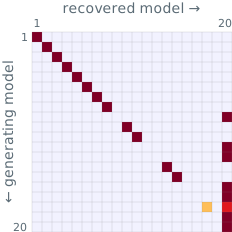
Test Each fitted model in turn generates synthetic judgments; all 20 are refitted to those from scratch and compared on held-out judgments.
One of the 20 as the generator
Its simulated judgments
All 20 refitted to them
The ranking: is the generator on top?
Result Recovery improved as the simulated experiment grew, then leveled off below 80%: far above the one in twenty of guessing, but wrong more than one time in five, even with millions of simulated trials. Regression analyses linked the misidentifications mainly to how much the fitted linear mapping reshapes a model’s representational geometry.
Scope This holds for the task, model set, noise calibration and linear transformation family we evaluated; it is not a claim that every flexible evaluation fails. It means a comparison can predict well and still be unreliable for identification, so the comparison itself needs a recovery test.
Questions the paper leaves open
- How much freedom should an evaluation give the mapping, given what we want the comparison to identify?
- How should a recovery test be built when the true system — in a real experiment, a brain — is outside the candidate set?
- How should a comparison treat the variability of responses within and between people?
Cite (BibTeX)
@inproceedings{avitan2025modelbehavior,
  title     = {Model--Behavior Alignment under Flexible Evaluation: When the Best-Fitting Model Isn't the Right One},
  author    = {Avitan, Itamar and Golan, Tal},
  booktitle = {Advances in Neural Information Processing Systems},
  volume    = {38},
  year      = {2025},
  doi       = {10.52202/085713-0404}
}